If you’re still writing your feeding instructions on paper or copying and pasting the same client message every day, this one’s for you.
Technology can feel overwhelming, especially when you’re already juggling a million things. But the right tools aren’t about being flashy; they’re about saving you time, keeping your team consistent, and helping you run a more peaceful, professional business.
Here’s a breakdown of some digital tools and categories to help you think through what could work for your pet care business.
Software That Makes Admin Easier
Google Docs or Forms for daily reports, check-in logs, or client info updates.
We use a Google Doc for tracking things like labor, attendance, injuries/illnesses, and general information our front-facing team needs in a pinch.
Forms are a great free tool to survey your team or clients to get valuable feedback about your services and culture.
QuickBooks (or similar) to streamline bookkeeping and keep you ready for tax season.
Texting capabilities within your scheduling or CRM software for quick, trackable client communication.
At our facility, texting has been an absolute game-changer. We can quickly copy and paste communication into notes that last forever and it helps with the anxiety of phone calls. The customers love the convenience of it, too!
Canned templates for email and SMS responses to save your team from writing the same thing 100 times.
Having a resource filled with the emails and messages you send every day will save your team tons of time in re-writing the same thing over and over. Consider things like: behavioral notes, health concerns (like throwing up bile), asking for reviews, general overviews of services, etc.
Not only are these faster, it ensures the message that goes out to everyone is branded, consistent, and clear.
Smarter Scheduling and Payroll
Homebase, Paychex, or ADP for scheduling shifts, managing time-off requests, and syncing payroll.
Payroll takes a lot of time and energy, so finding software that can mix payroll, scheduling, reviews, and documentation is a win.
Google Calendar for visualizing service flow, facility usage, or appointments.
We share our facility calendar with our front desk, trainer, and more so that everyone can see events, marketing goals, and holidays in one place.
Pro tip – you can even use Google Calendar in place of software like Calendly now. Even I even use it to schedule consultation calls, and the best part is, it reads your schedule so it never overlaps commitments.
ClickUp or other checklist software to track recurring tasks or onboarding steps.
Checklists are a huge topic in our industry. If you find a software you like that keeps consistent and easily adjusted checklists for your team, you will save a lot of time and energy.
We use ClickUp because it has the ability to be extremely flexible with dates (like recurring tasks scheduled every 3rd day, etc.) and I can add training links, policies and procedures directly to the task so I am sure they are being done right.
Slack or ConnectTeam to keep internal communication in one place (instead of messy group texts).
Communication is key to success! Having a setup that allows targeted communication within your team is a must. Plus, you can set up extra channels or groups for culture builders like: sharing gifts from customers, holiday pictures, shout-outs, and more!
This can be a cheap one, too. Slack has a completely free and fully functional option!
Marketing and Online Presence
Google Business Profile updates and reviews are one of your most powerful tools.
Planable or Meta Business Suite for scheduling social posts.
Canva (or Illustrator if you’re fancy) for easy, clean graphics.
ChatGPT for SEO support, content brainstorming, or market research.
Chatbots and autoresponders for instant replies on your website, Facebook, and Instagram.
Tools That Improve Client Communication
Report card apps or shared digital forms to give clients quick updates.
Grammarly to make sure written communication stays professional.
QR codes that link to service menus, client portals, or reviews.
Walkie apps (like Voxer) for fast team updates during busy shifts.
Suggestion: Start Small.
You don’t have to overhaul everything overnight. Start with one system you know is costing you time or energy. Whether it’s switching to digital checklists or building out your canned text templates, small changes add up fast.
If you want help figuring out where to improve your operations, feel free to schedule a call HERE.
The Ostrich Rule Problem: Why Your Policies Aren’t Working
We set rules, policies, and procedures all the time. Whether it’s for clients, for staff, or both. But sometimes we forget that just having a rule doesn’t mean it will be followed. It has to be clear, accessible, and enforceable.
I was reminded of this recently at a petting zoo we visited in Tennessee.
At check-in, we got the option to buy a grain cup and an apple to feed the animals. And we were told: “Don’t feed the ostriches your grain. They get their own feed from the special coin-operated machines near their enclosure.”
No problem. Except… those machines only took coins, and the zoo didn’t make change. Since it was in the middle of nowhere, there was nowhere to go, so we entered with the knowledge that the Ostriches just weren’t going to be fed by us.
By the time we made our way over to the ostriches, not only were the coin-operated machines completely empty, but the only signage reminding guests not to feed them from their own cups was one tiny, faded, easy-to-miss sign.
We stood there for maybe five minutes and watched person after person feed the ostriches exactly what they weren’t supposed to.
Not because they were trying to break the rules. But because the rule was:
Easy to forget
Not reinforced
And nearly impossible to follow correctly given the circumstances
That got me thinking about how often we do the same thing in our businesses.
Can you think of a policy you’ve made that doesn’t consistently get followed?
I’d bet it’s because it’s not obvious, not clearly communicated, or not supported with systems that make following it easy and consistent.
Here’s a quick example from my own pet care facility:
We’ve always asked for client pickups before noon. It was on the website, in the automatic emails, in our phone scripts…really, it is everywhere.
Then we added a late pickup fee for anyone picking up after noon to help cover the extra care time.
And that’s when things got complicated.
Some clients “didn’t know” about the fee (despite the info being everywhere). Some team members forgot to charge it. Others felt bad about enforcing it with long-time clients. Some waived it just to avoid conflict.
It was inconsistent, uncomfortable, and ultimately ineffective.
What finally worked?
We automated the fee in our software system.
We added it to the client agreement so everyone had to sign off.
We locked down the ability to waive it so only the managers could make exceptions.
And we emailed every client in our system, so there was a documented, date-stamped communication trail. Once we did all that? The rule became normal. It didn’t feel like a personal judgment, and it wasn’t up for debate. No one had to “remember” to do it; it just happened.
So if there’s a rule your team struggles to enforce, ask yourself:
Is the rule easy to understand?
Does your system back it up automatically?
Can your team follow it without having to make judgment calls?
Are you giving them the tools and permission to enforce it consistently?
The more you reduce friction, the easier it is to build a culture of consistency.
Policies only work when they’re practical, visible, and backed by structure. So if a rule keeps getting broken, it might not be about the people, it might be about the setup.
Need Help?
Want to update your policies and tighten up systems? Book your free consult and let’s dig in together.
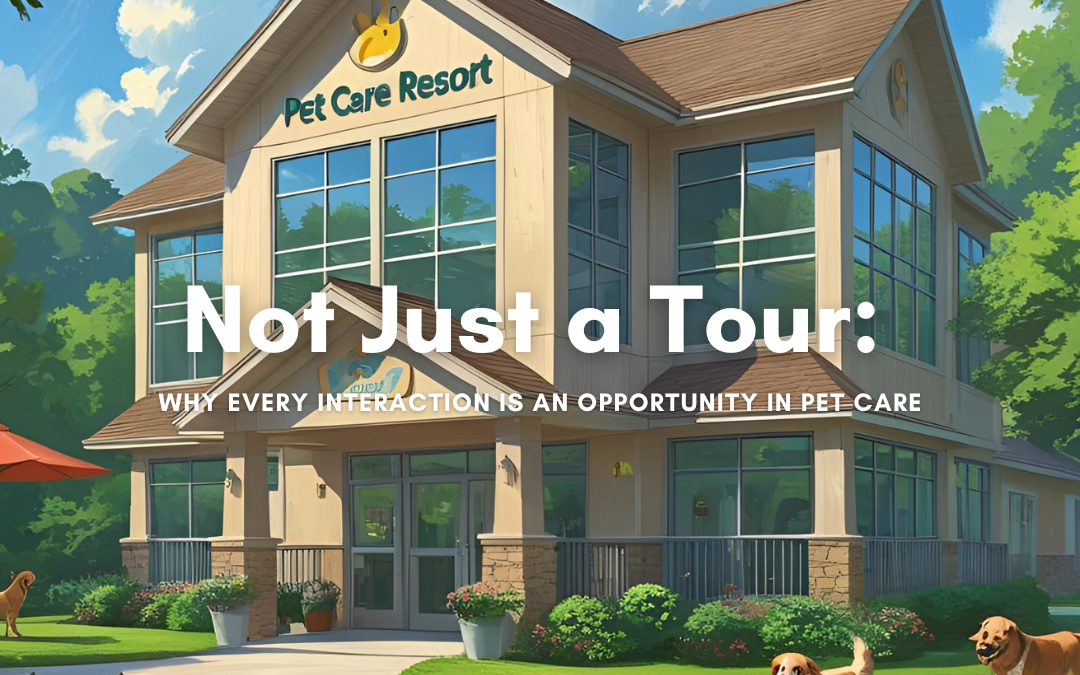
Not Just a Tour: Why Every Interaction is an Opportunity in Pet Care
A few weekends ago, I was out of town and decided to call a local pet resort just to ask if I could stop by for a tour. I told them straight up that I wasn’t a mystery shopper or pretending to be anything I’m not. I said, “I operate a pet resort a few states away, and I’d love to learn from you while I’m in town.” I even offered them the same courtesy if they ever found themselves in Ohio.
They said yes.
So, I showed up the next day. I walked in, got a warm greeting at the front desk, and was asked if I was picking up a pet. I let them know I had called the day before about a tour and that I ran a facility out of state.
And just like that, the vibe shifted.
Their faces dropped. The friendliness vanished. It felt like I had just told them I was a burglar instead of a fellow professional.
I waited… and waited. After about 20 minutes, a manager finally came out. Arms crossed, zero smile, completely closed off. I wasn’t sure if I had caught them at a bad moment, or if they just didn’t like the idea of someone from “another” facility walking through. Either way, I was already uncomfortable.
We walked quickly through the space. She barely paused to explain anything—just pointed at areas and moved right along. When I asked a simple question about their fencing (and complimented it, trying to keep things kind), she just said, “I don’t know,” and stood silently until I gave up and said thank you. Then she escorted me back to the front and wished me a good day.
I left feeling… unwelcome. But more than that, I left disappointed. Because here’s the truth:
We are a tight industry of many private business owners. And way too often, we operate with fear.
Fear that someone’s going to steal our ideas. Fear that someone’s going to open a facility down the road. Fear that if we share too much, we’ll lose something.
But here’s the truth:
1. They could have learned just as much from me as I hoped to learn from them. This wasn’t some secret audit. I was offering a connection, a peer-to-peer moment. Who knows what kind of conversations we could have had?
2. There are millions of pets in the world, and every one of us does things differently. Sharing isn’t a threat. It’s part of how we grow. Your version of “playtime” or “luxury” isn’t the same as mine, and that’s okay. Clients will pick what works for them.
3. You never know who you’re really talking to. Maybe I wasn’t their customer that day. But I’ve got clients who move all the time. Do you think I’m going to recommend that place now? Not likely. Every interaction is an impression and you don’t get to choose which ones turn into referrals.
4. The team is always watching. That manager showed her front desk (and whoever else she talks to) that it’s okay to be dismissive, cold, and closed off when someone doesn’t seem “valuable” enough. What does that teach them about how to treat people?
In this industry, how we treat people—clients, staff, even each other—matters. Hospitality is the job. Whether someone is dropping off a dog or asking for a tour, they should walk away feeling seen, respected, and welcomed.
I’m not saying you have to spill every operational secret. But the kind of business culture that keeps everything locked up tight out of fear? It’s not going to get you very far.
So let’s lead differently.
Let’s share, connect, and be proud of the work we do—confident enough to let someone else see it.
It is hard to really make a connection with people in such a fast-paced world. Everyone is concerned with what is revolving around in their head in the moment and not always with giving you the attention needed to make a connection.
Just like with social media, you need a hook to fully capture the attention of someone and begin a conversation.
Conversation Hooks: 1. Ask a question that causes consideration. Asking a question that forces someone to give their full attention to the answer will stop other thoughts in their track and refocus their energy on you. Make sure the question is meaningful to your upcoming conversation and can be looped into the next strand of thought. For example: You want to connect with a customer in the lobby of your retail business. You: “Can I ask you a question?” Them, stopping and facing you: “Sure.” You: “I was just looking at your glasses and love the design. Did you have to custom-order them to be that unique?” Them: Is flattered and begins to tell you where they got them and why they chose them. You: “I absolutely love them and will have to check that out. I feel like everything from the stores all looks the same and am always impressed with new looks that showcase an awesome personality. It’s what we try to do here in this store, too. Have you come across something you like already?”
2. Find the Connection. Now, this isn’t as easy as “Hey! We have the same Apple Watch!” and needs to be something that puts you into a new category in their brain. You want to go from “another nearby human” to “a potential contact/friend” or “someone like me!” If you are in the same place of business as someone else, notice what they are looking at or doing and find something that puts you on their “side” or in their same “category.” For example: You: “I put that shirt back, too. Don’t you think it seems a little 1990s?” Them: “Yes! I was thinking the same thing!” You: “Maybe I just can’t keep up with the fashion trends anymore. They seem to change so fast! Do you think they will bring back __________? I loved those when I was in college.” Them: “Oh I hope so, I also had some and wish I had them still!” From here, you can shift the conversation to anything else, as long as they are not giving you signals that they are trying to go about their day.
3. Ask Questions About Them. Everyone loves to talk about themselves because, well, it is one of our best-known subjects! The trick here is – you can’t just approach anyone in the street and start bombarding them about their history and interests. The timing has to be right – maybe you are at a dinner party and already sitting next to someone that you don’t know well. Maybe you are in line with someone for a period of time and there is nothing better to do than make the best use of time by enjoying some conversation. When you do have the right timing, here are some key questions that will help you move from “stranger” to “connection”: “How did you end up here?” -and from there, you glean information about their current situation and what drove them to this point in which they are graced with your presence. Search through their answer to find new points of connection to build on. “What do you do for work?” Is an easy one to build on. Yes, it is small talk but grows into more if you find that connection within their answer. Maybe you use their services already or have need of them. Or, you can find an off-the-wall question that startles out a laugh and a good time. “Why do you think manhole covers are round instead of square?” – be careful though, the answer from a stranger will probably be “I don’t know” and you’ll have to follow it up with your own opinion to see if you can hook them into a friendly debate.
4. Do Something Nice: Now, don’t start approaching strangers loading groceries in their car and loading their bags to begin a conversation. That’s just creepy. I would, however, encourage you to keep your eyes open for opportunities around you in the frame of mind of “how can I be of service.” Maybe a kid is throwing a tantrum in the grocery store and you just happen to have a goofy toy left in your purse. See if you can make the kid a bit happier and give their harassed parent a break. This will open the door to a meaningful connection and conversation because that person appreciates you and is very willing to give you some time for your help in their day.
There are so many ways to make connections with people that we would typically not befriend. In today’s world, we are less-likely to be engaging with stranger nor be engaged with by strangers. But, I truly think that most people want those connections and a good random conversation with a random person spurs good vibes for the rest of the day.
I encourage you to try it out. You’ll fail at making connections and get some weird looks but hey, they will probably forget about it in a few days or, with any luck, you still made them smile (even if it was at your expense) and you can walk away knowing that you did have an impact on that person, even if it wasn’t quite what you had in mind.
Practice engaging and making connections with strangers. How did it go? I would love to hear the charming stories!